Free handbook · 42 pages · Marram 2026
AI is already working in your area. Who is responsible for its quality?
AI assistants and agents already do HR, quality and communications work. They use your organisation’s guidelines, interpret information and prepare decisions. The Context Owner’s Handbook shows how to make sure they apply your company’s approved principles correctly, and where to start.
Practical examples · Worksheets · PDF, Markdown and the Context Check skill
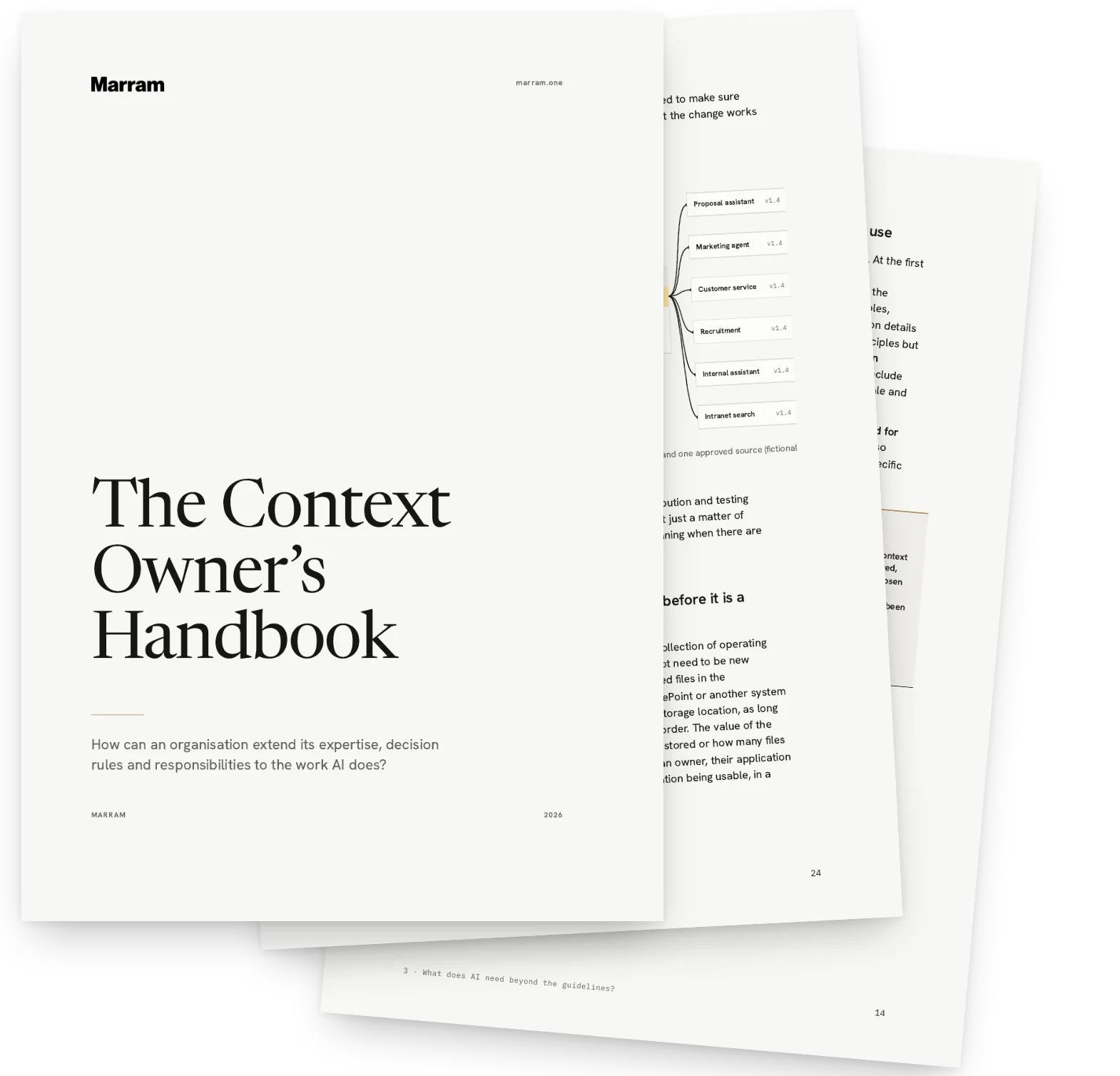
A new kind of handbook
One handbook, three formats.
Why now
Your area has new workers.
The quality director is still responsible for quality, the HR director for HR principles and the communications director for the company’s communications.
AI tools now use the knowledge of their areas too, often tools they did not build or introduce themselves. This raises three questions:
- Where does AI get the organisation’s approved operating principles?
- Who makes sure it applies them correctly?
- How do we know the quality of its work is good enough?
These are not IT questions.
What the handbook gives you
Four things you can take to your leadership team.
A new perspective on your leadership responsibility
How the work AI does relates to the existing responsibilities, quality criteria and decisions of your area.
Where trust in AI’s work comes from
Why checking afterwards is not enough on its own, and how to build the conditions for reliable work in advance.
A model for shared context
Which knowledge is owned in common and what belongs in the instructions of an individual AI tool.
A practical way to start
How to choose your first body of content, identify the missing application guidance and define the tests.
- 1People are no longer the only ones working in your area
- 2Where does trust in AI’s work come from?
- 3What does AI need beyond the guidelines?
- 4Shared principles, different AI tasks
- 5How do you prepare expert knowledge for AI use?
- 6Who owns this, and where do you start?
- A–DContext map · Five test situations · Self-assessment · What to record
Examples
Well-founded questions. Concrete examples.
The handbook looks at the public company guidelines of KONE, Ericsson, Bosch, IKEA and Klarna. The examples show why finding the right document does not yet mean that AI can apply it as intended.
It also draws on the perspectives of Deloitte, Bain and Boston Consulting Group on AI adoption, the role of expert knowledge and managing an organisation’s own operating context.
The examples are based on public material. They are not audits of these companies’ AI systems.
Who it is for
For the leader of an area, not for IT.
For the people responsible for HR, quality, communications, marketing, safety, procurement and other functions. Especially if the guidelines, decision rules and expertise of your area are used in AI solutions now or soon will be.
You do not need technical AI skills. The handbook is about the quality of work, shared operating principles and leadership.
The Context Owner’s Handbook
How can an organisation extend its expertise, decision rules and responsibilities to the work AI does?
A handbook with practical examples, worksheets and questions for assessing your own area.
You get
- the handbook as a PDF for people and in Markdown for AI
- the Context Check skill for Claude and ChatGPT
Publisher: Marram
Models change. Your judgement stays.